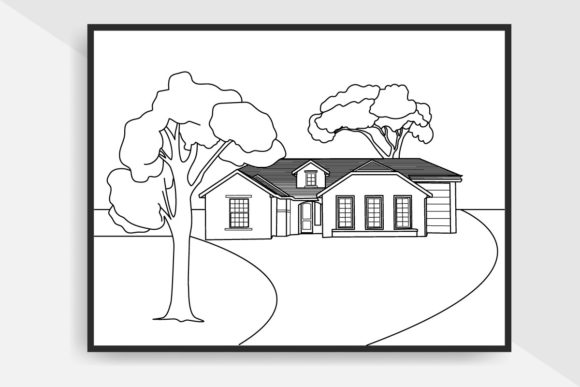
Hand Drawn Home Line Art Coloring Pages
A Designer’s First Look: Charm Without Clutter
Opening Hand Drawn Home Line Art Coloring Pages, I immediately felt the quiet warmth of a well-considered sketchbook—not overworked, not overly stylized, but intentionally unpolished. The lines are confident, slightly uneven, with gentle tapering and organic weight shifts. It’s the kind of drawing that feels like it was made with a fine-tip pen on textured paper: soft corners, no hard vectors, no forced symmetry. That’s critical for embroidery. Unlike rigid digital icons, this line art breathes—giving stitchers room to interpret, adapt, and add handmade nuance.
Real Project Test: Embroidering a Linen Kitchen Towel
Last week, I used one of these home motifs—a simple two-story house with a slanted roof, chimney, and front door—to embroider a 100% linen tea towel for a local boutique. I digitized it as a clean running stitch outline (no fill), sized to fit comfortably in a 4” hoop. The result? Crisp, legible, and quietly elegant. Customers noticed it instantly—not because it shouted, but because it *belonged*. That’s the strength of Hand Drawn Home Line Art Coloring Pages: its visual personality supports storytelling, not just decoration. It fits naturally on nursery pillows, baby onesies, aprons for artisan bakers, or even embroidered patches sewn onto denim jackets.
Where It Shines—and Where It Needs Care
This design excels in low-density, outline-based embroidery projects: tote bag monograms, sweatshirt chest logos, minimalist cap fronts, or pillow covers where subtlety reads as sophistication. Because the lines are hand-drawn—not pixel-perfect—it handles fabric movement gracefully. On slightly stretchy cotton blends or lightweight knits, the natural variation in line weight helps disguise minor tension shifts during stitching.
But be thoughtful with execution. Tiny windows or delicate fence posts may lose clarity under dense satin stitch or heavy fill stitch—especially on textured fabrics like terry cloth or bouclé. On dark fabric, avoid light thread unless you’re using high-contrast stabilizer underneath. And on curved surfaces like baseball caps, simplify or omit fine interior details (like doorknobs or shingle lines) before digitizing. For baby embroidery or items meant for frequent washing, test stitch density: too many overlapping stitches can stiffen delicate fabrics or cause puckering.
Commercial Use Considerations for Etsy Sellers & Small Shops
If you’re an Etsy seller or small shop owner building a cohesive brand around “cozy home,” “slow living,” or “handmade domesticity,” Hand Drawn Home Line Art Coloring Pages is a smart asset. It pairs seamlessly with neutral palettes, natural fibers, and minimalist packaging. But remember: as a coloring page graphic, it’s not pre-digitized. You’ll need to convert it into a machine embroidery design yourself—or work with a digitizer who understands how hand-drawn line weight translates to stitch behavior. Don’t assume it’s ready for your Brother or Bernina out of the gate.
Also, verify licensing. The product description says you can “purchase this file and gift it”—but doesn’t clarify whether commercial embroidery rights are included. If you plan to sell finished embroidered products (like personalized pillow covers or custom aprons), confirm whether the license permits derivative physical goods. When in doubt, reach out to the creator before listing on your shop.
Design Judgment: Beyond Aesthetics
What makes Hand Drawn Home Line Art Coloring Pages more than just pretty? It builds trust. Hand-drawn elements signal intentionality and care—something buyers increasingly associate with authentic handmade products. A customer choosing a custom embroidered baby blanket with this motif isn’t just buying decor; they’re investing in a feeling: safety, memory, belonging. That emotional resonance lifts perceived value, supports premium pricing, and encourages repeat purchases.
For craft business owners, it also strengthens brand consistency. Used across multiple product types—tea towels, patches, greeting cards, and digital printables—it creates visual continuity without repetition. Just vary scale, placement, and thread color: charcoal gray on oatmeal linen for a modern kitchen line; soft sage on ivory cotton for nursery gifts.
Practical Notes Every Embroidery Designer Should Check
- Test first: Stitch a sample on scrap fabric matching your final project’s weight and texture.
- Review contrast: Try black and white thread mockups against light and dark backgrounds—what reads clearly at 3” may vanish at 1.5”.
- Check stabilizer needs: Linen and loosely woven fabrics demand medium-weight cutaway or tear-away; skip lightweight iron-ons here.
- Confirm hoop compatibility: Some home motifs span wider than standard 4x4 hoops—measure before digitizing.
- Inspect detail integrity: Zoom in on corners, intersections, and thin stems—do they hold up when scaled down?
- Compare applications: Does the same motif work equally well as a standalone patch versus a repeating border on a pillow cover?
- Validate commercial use: If selling finished embroidered goods, ensure your license covers physical derivatives—not just personal use or digital resale.
Final Thought: A Quiet Anchor for Your Creative Work
Hand Drawn Home Line Art Coloring Pages won’t dominate a shelf or stop scrollers mid-feed—but it will linger in memory. It’s the kind of design that earns a second glance on a boutique apron, invites touch on a linen pillow, and feels meaningful on a holiday gift tag. For embroidery designers and creative entrepreneurs who value authenticity over flash, it’s not just another graphic. It’s a quiet, reliable anchor—ready to translate your vision into something tactile, thoughtful, and truly made.