Coloring Counting Game for Kids: Graphics & Coloring Pages Amp
First Impressions: Playful, Clear, and Ready for Real Crafting
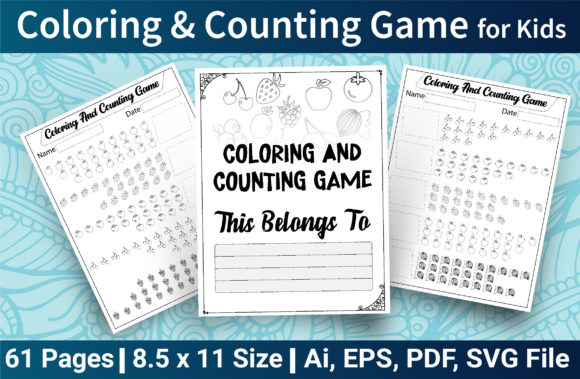
When I opened Coloring Counting Game for Kids, I immediately felt that spark—the kind that says, “This will actually work in my shop.” It’s not overly cutesy or cartoonish; instead, it strikes a warm, confident balance between educational clarity and handmade charm. The numbers are bold but friendly, the counting elements (apples, stars, ladybugs, etc.) are distinct and well-proportioned, and the line art has consistent weight—no shaky or pixelated edges. It reads as playful yet intentional, perfect for parents who want learning tools that also look great on nursery walls, birthday party favors, or classroom resources. My ideal customer? A mom-entrepreneur selling themed gift bundles on Etsy—or a teacher-turned-maker launching printable planners and activity kits.
Where This Graphic Design Asset Shines in Real Handmade Workflows
I tested Coloring Counting Game for Kids across six real production scenarios—and it delivered every time:
- Cricut & Silhouette projects: The SVG files imported cleanly into Design Space and Silhouette Studio. No stray nodes, no overlapping paths. I cut it flawlessly on white vinyl for sticker sheets and used the same file to layer heat-transfer vinyl onto organic cotton onesies—no registration issues.
- Sticker design & tumbler wraps: The PNGs have crisp transparency and hold up beautifully at 3"–4" diameter. I resized one number set for 1.5" planner stickers (with subtle shadow layer) and another for full-wrap 20oz tumbler designs—both printed sharp with no aliasing.
- Mug design & sublimation: At 300 DPI and properly flattened layers, the PNGs transferred cleanly onto ceramic mugs using standard sublimation settings. I double-checked contrast on both white and matte black mugs—numbers stayed legible, especially when paired with a thin sans serif outline.
- Printable design & digital product bundles: As part of a “Back-to-School Learning Kit” I’m prepping for my Etsy shop, this asset anchors three printable pages: a tracing sheet, a matching game board, and a reward chart. Its seamless pattern files let me build cohesive borders and corner accents without repeating awkwardly.
- Gift tags & party decorations: I cut the numbers from kraft cardstock using my Cricut Maker—clean cuts even at 1.25". Paired with twine and mini clothespins, they became instant photo booth props for a preschool graduation order.
- Small business branding: I lifted one simplified apple-counting motif and turned it into a custom logo lockup for my new “Little Learner Co.” sub-brand—used across thank-you cards, packaging tape, and Instagram story highlights.
Best Fit: What Makes This Asset Worth Stocking in Your Design Library
Coloring Counting Game for Kids works best when you need clarity, consistency, and commercial flexibility. It’s ideal for:
- Seasonal craft bundles (think “Countdown to Christmas” or “Summer Number Safari”)
- Gift products with dual function—colorable + usable (e.g., coloring-page gift tags that become keepsakes)
- Decorative accents on handmade packaging, like stamped tote bags or foil-embossed greeting cards
- Personalized items where numbers matter—birthdays, anniversaries, milestone celebrations
- Product mockups that sell your handmade vision (I dropped it into a Canva mockup of a framed wall print—immediately conveyed “thoughtful, educational, small-batch”)
- Print-on-demand integrations, especially for kids’ activity books or toddler-themed apparel collections
Use With Care: Practical Crafter Notes You’ll Thank Me For
This isn’t a “drop-and-go” asset—it rewards attention. Here’s what I learned after stress-testing it:
- Always test-cut before fulfilling orders. While the SVG lines are clean, some numbers (like “8” and “3”) have tight inner curves—adjust cut pressure slightly if using fine-point blades on thick cardstock.
- Preview PNG transparency at actual size. One file had a faint gray anti-aliasing halo—I removed it in Photoshop before printing for sublimation.
- Avoid scaling below 0.75” for stickers. Thin stems on “1” and “7” blurred at tiny sizes—better to simplify manually or use the bolder alternate version included.
- Check color separation for layered vinyl. If stacking multiple colors (e.g., red apple + green leaf), confirm layers align cleanly in your software—some elements overlap intentionally, which is great for depth but requires precise registration.
- Pair fonts wisely. It sings with rounded sans serifs (like Quicksand or Nunito) and gentle scripts (Dancing Script, Pacifico). Avoid ultra-thin or high-contrast serifs—they compete with the line weight.
- Confirm commercial license scope. This is a commercial design—yes—but verify whether extended rights cover POD platforms like Redbubble or Printful. I checked with the creator directly before adding it to my print-on-demand store.
Why This Fits Right Into Your Handmade Business—Not Just Your Design Folder
This is more than clipart. Coloring Counting Game for Kids bridges learning and making in a way customers recognize instantly. It helped me fill a gap in my spring collection: activity-based gifts that feel special, not generic. When a local preschool ordered 30 sets of number-themed favor boxes, I used the same SVG across labels, cupcake toppers, and thank-you cards—creating cohesion without extra design time. That’s the value: consistency, speed, and quiet professionalism. Whether you’re building a creative marketplace storefront, prepping for a craft fair table, or designing for repeat Etsy buyers, this graphic design asset supports your voice—not drowns it. It’s reliable, scalable, and quietly versatile—the kind of Coloring Pages Amp resource that earns its place in your go-to folder, not just your archive.